



















































Schengen 90/180-Day Rule Explained With Travel Examples
-
Anum Naeem
- Last updated:
- 4 min read

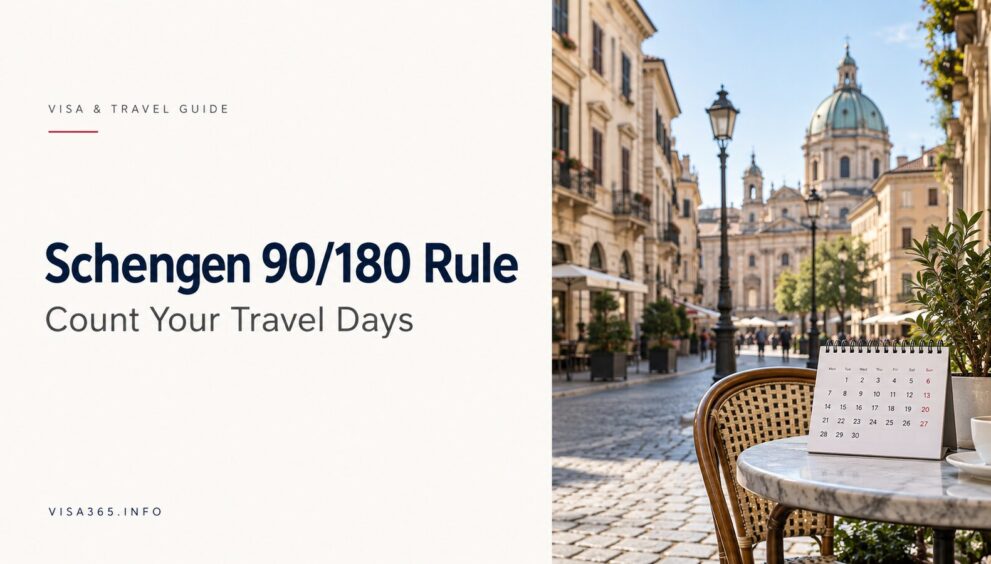
The Schengen 90/180-day rule uses a rolling window. It does not automatically reset when you cross a border, change hotels, or begin a new calendar month. For each day of a covered short stay, you need to check how many relevant days fall within the preceding 180-day period.
This guide uses simple examples to explain the calculation. It should be read with your travel permission. Our Schengen Type C visa guide explains why a visa’s validity period and its authorized stay are different.
What the 90/180-day limit means
The European Commission’s short-stay calculator guidance describes a usual maximum of 90 days in any 180-day period for the short stays concerned. The reference period moves forward with the date being checked.
A visa can authorize fewer days. If your sticker permits only a shorter stay, a calculation showing unused days does not override that limit. The number of entries and the visa’s start and expiry dates also need separate attention.
Count the journey as one Schengen stay
Changing from one Schengen country to another does not start a fresh allowance. For example, a holiday split between France and Germany is not two independent 90-day allowances. Keep one travel record for the area.
The official calculator manual explains how entry and exit dates are entered. Count both the arrival and departure day when preparing a covered short-stay calculation.
Three examples that make the rule clearer
Example 1: A short single trip
Suppose you enter on 1 October and leave on 10 October. Counting both dates gives 10 days, not nine nights. With no other counted stays in the relevant window, this is the figure to record for that trip.
Example 2: Two trips within the same window
Suppose a traveler has 30 counted days from an earlier visit and plans another 20-day visit. If all those days remain inside the reference window, the combined total is 50 days. The second trip does not start from zero.
Example 3: A visa with a shorter allowance
Suppose the visa authorizes 15 days and the itinerary covers 20 days. Having unused days under a general 90-day calculation does not make that itinerary valid under the sticker. The shorter authorized stay still needs to be respected.
These are simplified examples, not an assessment of a particular travel history. Several visits near the edge of the rolling window should be checked using exact dates.
Use the official calculator in the right mode
- List the relevant entry and exit dates for previous short stays.
- Choose check mode for a past or ongoing stay, or planning mode for a proposed entry.
- Enter dates in the format requested by the tool.
- Match each entry with the correct exit.
- Review the result and compare it with the separate visa conditions.
Do not include an unrelated period without checking the guidance. The Commission explains that periods authorized under a residence permit or long-stay visa are treated differently. Such documents do not create a general permission for unrestricted travel in every other country.
A travel log is better than a rough estimate
Our practical recommendation is a simple spreadsheet with country, entry date, exit date, and supporting booking reference. Record an actual change of plan when it happens. Counting only hotel nights or relying on memory makes errors more likely.
Read our Schengen visa application guide for the separate document process. Neither the calculator nor a travel spreadsheet grants permission to enter.
Frequently asked questions
Does the allowance reset on 1 January?
No. The calculation uses a rolling 180-day period, not the calendar year.
Does a weekend outside Schengen create another 90 days?
No. Earlier counted days remain relevant while they are inside the rolling window.
Can I stay 90 days if my visa says 30?
No. The visa’s shorter authorized stay remains a separate limit.
Is the calculator an entry guarantee?
No. It assists a stay calculation. Other travel and entry conditions still apply.
Editorial check: 31 October 2026. Examples are illustrative. Verify your exact dates, travel permission, and any applicable exceptions with official guidance.
Disclaimer: This guide is for general informational purposes only and does not constitute legal advice. Visa requirements may change. Always verify with official government sources.
Was this article helpful?
Thanks for your feedback 💛 It helps us improve our guides.