





















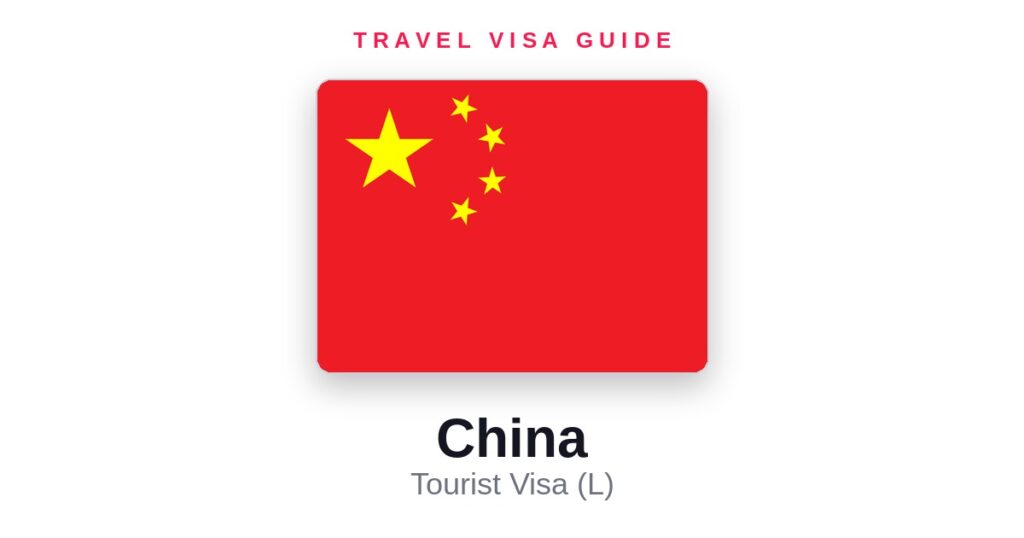


























































China Tourist Visa (L): Requirements and How to Apply
-
Maimona Naeem / 2 months
- August 17, 2026
- 8 min read

China draws millions of leisure travelers every year, from the Great Wall and the Forbidden City in Beijing to Shanghai’s skyline, Xi’an’s Terracotta Army, and Guilin’s karst landscapes. For most foreign visitors coming purely for sightseeing, leisure, or individual and group travel, the relevant document is the Tourist Visa, known by its category letter, the L Visa.
This guide covers who actually needs an L Visa, what’s changed with China’s recent visa-free expansion, what documents to prepare, how much it costs, and how the application process works. For more on China’s other visa categories, see our China visa hub.
What Is the China Tourist Visa (L)?
The L Visa is issued to foreign nationals traveling to China for tourism, sightseeing, or visiting friends and relatives, whether as an individual or as part of a group tour. It’s one of several letter-coded Chinese visa categories – separate from the M Visa (business), X Visa (study), Z Visa (work), and others – and it does not permit employment, formal study, or journalism-related activities while in the country.
L Visas are generally issued as single-entry or double-entry, with the visa’s own validity window (the period during which you must enter China) typically running 3 to 6 months from issue, while the permitted length of stay per visit is set separately and can range from 30 to 90 days, depending on your nationality and what the issuing mission decides to grant. It’s worth checking both figures carefully once your visa is issued, since the visa’s validity and your permitted stay length are two different things.
Do You Actually Need an L Visa? China’s Visa-Free Expansion
Before assuming you need to apply for an L Visa, check whether your nationality already qualifies for visa-free entry. Since late 2023, China has substantially expanded a unilateral visa-free policy, adding dozens of countries – including most of the European Union, the United Kingdom, Canada, Australia, New Zealand, Japan, South Korea, and a number of others – allowing citizens of those countries to enter China for tourism, business, family visits, and similar short-term purposes for up to 30 days without a visa. This policy has been extended multiple times and, as of this writing, runs through December 31, 2026, though further extensions are possible.
Not every nationality is covered – the United States, for example, is not currently on the unilateral visa-free list – and the list of eligible countries continues to change, so it’s essential to check the current list on China’s official Consular Service Network before assuming either that you need a visa or that you don’t. Separately, China also offers a 240-hour (10-day) visa-free transit policy for eligible travelers passing through to a third country, and Hainan Island runs its own broader visa-free arrangement – both of which are distinct from the general 30-day unilateral policy and come with their own conditions.
If your nationality isn’t covered by any of these exemptions, or if your trip doesn’t fit the visa-free policy’s conditions, you’ll need to apply for the L Visa in advance.
Documents and Requirements
Applicants who need to apply for an L Visa should generally prepare:
- A valid passport, with at least six months’ remaining validity and at least two blank visa pages
- A completed visa application form, generated and submitted through the official online system, then printed and signed by hand (digital signatures are not accepted)
- A recent passport-style photograph, meeting the specific size and background requirements published by the visa center
- Proof of round-trip or onward travel, such as a flight itinerary or ticket confirmation
- Proof of accommodation, such as a hotel booking confirmation for the full duration of the stay, or an invitation letter if staying with family or friends
- A detailed travel itinerary, particularly for longer or multi-city trips
- For some nationalities, proof of sufficient financial means, such as recent bank statements
- For naturalized citizens born in China (including Hong Kong, Macau, or Taiwan) applying for the first time, additional documents such as a birth certificate or proof of former Chinese citizenship status
Because requirements can vary by nationality and by which Chinese embassy, consulate, or visa center is handling the application, it’s worth checking the specific checklist published for your location before submitting.
How to Apply
Step 1: Confirm whether you need a visa at all.
Check the current unilateral visa-free list and the 240-hour transit policy to see whether your trip already qualifies for visa-free entry.
Step 2: Create an account and complete the online application.
Applications begin through China’s official visa application system, where you fill in your travel and personal details and upload the required documents for a preliminary review.
Step 3: Address any feedback from the preliminary review.
The review stage typically takes a few business days, during which the visa center or embassy may request corrections or additional information before you can proceed.
Step 4: Book an appointment at a visa center.
Once your online application is approved, you’ll need to schedule an in-person appointment through the Chinese Visa Application Service Center serving your region, since most centers operate strictly on an appointment basis.
Step 5: Attend your appointment and submit biometrics.
Bring your printed, signed application form, passport, photograph, and all supporting documents to your appointment, where fingerprints are typically collected (unless you’ve had fingerprints taken at the same location within the past five years).
Step 6: Pay the applicable visa fee.
Fees vary considerably by nationality, since China applies a reciprocity-based fee structure – meaning citizens of countries that charge Chinese nationals higher visa fees tend to pay more for a Chinese visa, and vice versa. Confirm the current fee for your nationality directly with the visa center handling your application.
Step 7: Track and collect your passport.
Processing typically takes several business days, though expedited options may be available at an additional cost depending on the visa center. Once approved, your passport will be returned with the visa affixed.
Extending Your Stay in China
If you need to remain in China beyond the stay period granted on your L Visa, you can apply for an extension at the local Exit and Entry Administration – a division of China’s National Immigration Administration – generally before your current visa expires. Extension applications typically require your passport, a completed application form with a recent photograph, proof of registration of temporary residence, and your travel itinerary. If approved, the extension generally cannot exceed the length of your original stay period, and there’s no guarantee of approval, so it’s best to apply well ahead of your visa’s expiry rather than at the last moment.
Frequently Asked Questions
Do I need a visa to visit China as a tourist?
It depends on your nationality. China has significantly expanded its unilateral visa-free policy, and citizens of many countries, including most of the EU, the UK, Canada, Australia, and several Asian nations, can now enter for tourism, business, or family visits for up to 30 days without a visa. Other nationalities, including the United States, still need to apply for the L Visa in advance.
What’s the difference between visa validity and permitted stay length?
Your visa validity is the window during which you must enter China, commonly 3 to 6 months from the date of issue. Your permitted stay is how long you’re allowed to remain in the country per visit, which can range from 30 to 90 days depending on your nationality and what the issuing authority grants. These are two separate figures, both printed on the visa.
Can I apply for a China Tourist Visa online without visiting an embassy?
You can complete the initial application and document upload online, but most applicants still need to attend an in-person appointment at a Chinese Visa Application Service Center to submit original documents and have their fingerprints collected, except where an e-Visa pilot applies to your nationality.
How long does it take to process an L Visa application?
Processing commonly takes a matter of business days once your appointment has been completed and documents submitted, though this can vary by visa center and by whether expedited processing is available. Applying well ahead of your intended travel date is advisable.
Can I work or study in China on an L Visa?
No. The L Visa is strictly for tourism, sightseeing, and similar short-term visits. Anyone planning to work needs a Z Visa, and anyone enrolling in formal study needs an X Visa – both are separate categories with their own eligibility rules and documents.
What happens if I overstay my permitted stay in China?
Overstaying can result in fines, detention, or a re-entry ban, depending on the length and circumstances of the overstay. If you need more time, apply for an extension at your local Exit and Entry Administration office before your current visa or visa-free period expires.
Does the visa-free policy cover business trips too?
Yes, for the countries covered by the 30-day unilateral visa-free policy, the exemption generally applies to business visits, family and friend visits, tourism, and certain exchange activities, not just leisure travel. It does not, however, extend to activities like formal employment, study, or journalism.
How much does a China Tourist Visa cost?
Visa fees vary significantly by nationality, since China uses a reciprocity-based fee structure tied to what your home country charges Chinese citizens for a similar visa. Because of this variation, it’s best to confirm the exact fee for your nationality directly through the Chinese Visa Application Service Center or embassy handling your application.
Disclaimer: This guide is for general informational purposes only and does not constitute legal advice. Visa requirements may change. Always verify with official government sources.
Was this article helpful?
Thanks for your feedback 💛 It helps us improve our guides.