





































L-1 Visa: The Complete Guide to Intracompany Transfers
-
Maimona Naeem / 6 months
- April 16, 2026
- 10 min read

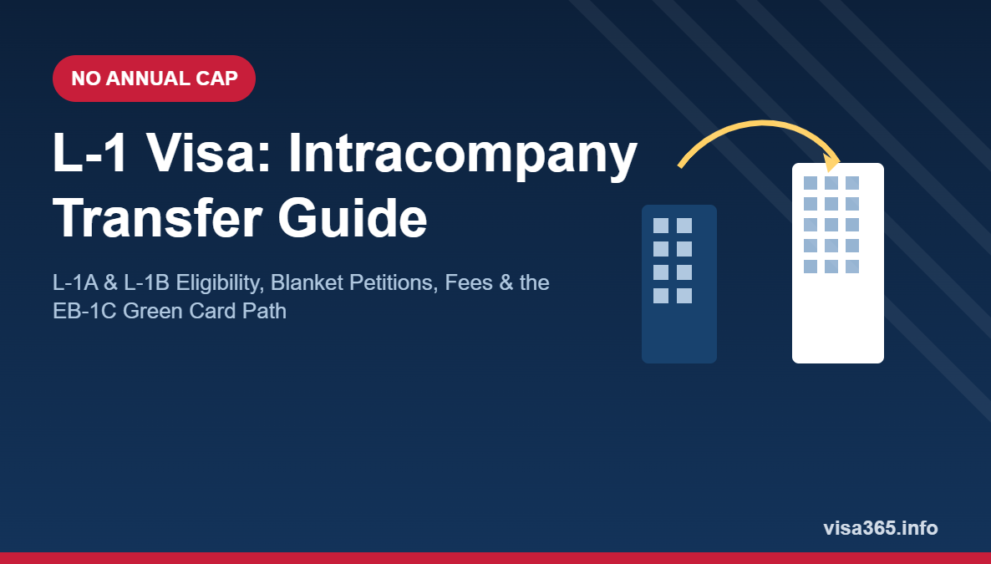
The L-1 visa allows multinational companies to transfer employees from a foreign office to a related US office, branch, subsidiary, or affiliate. It’s one of the more powerful employment-based visa categories available, since it comes with no annual cap and no lottery, and for many executives and managers, it opens a direct pathway to a US green card.
This guide covers the difference between the two L-1 subcategories, who qualifies, the new office rules for companies just establishing a US presence, blanket petitions for large multinationals, current fees, and how the L-1 connects to permanent residency. If your situation doesn’t involve an existing employer relationship abroad, it’s worth comparing this route to the H-1B specialty occupation visa instead, since eligibility works quite differently.
What Is an L-1 Visa?
The L-1 is a nonimmigrant, employer-sponsored visa that allows a company with operations in the US and abroad to transfer a qualifying employee into a role at its US entity. Unlike the H-1B, the L-1 doesn’t require Labor Condition Application wage attestations in the same way, and there’s no annual numerical limit or competitive registration lottery to worry about.
L-1A vs. L-1B: What’s the Difference?
The L-1 category splits into two subtypes, and the distinction affects both how long you can stay and whether the visa leads directly toward a green card.
L-1A: Managers and Executives
The L-1A category is for employees transferring into a managerial or executive capacity, meaning they hold genuine authority over people, a department, or essential company functions. L-1A status is typically granted for an initial period and can be extended, up to a maximum of seven years total.
L-1B: Specialized Knowledge Workers
The L-1B category is for employees with specialized knowledge about the company’s products, services, processes, or procedures that isn’t commonly available in the labor market. L-1B status can be extended up to a maximum of five years total.
L-1 Visa Eligibility Requirements
Both the employer and the employee must independently satisfy specific conditions.
1. Qualifying Corporate Relationship
The US and foreign entities must have a qualifying relationship, meaning the US company is a parent, subsidiary, affiliate, or branch of the same organization the employee worked for abroad.
2. One Year of Continuous Foreign Employment
The employee must have worked for the qualifying foreign entity continuously for at least one year within the three years immediately before the transfer to the US, in a managerial, executive, or specialized knowledge capacity.
3. Qualifying Role in the US
The employee must be coming to the US to work in a role that genuinely matches their category, meaning managerial or executive duties for L-1A, or work requiring the same specialized knowledge for L-1B.
4. Ongoing Compliance
Throughout the L-1 period, the employee must continue to meet the requirements of their category and comply with the terms of their status, since USCIS retains authority to conduct site visits to verify ongoing eligibility.
New Office L-1 Petitions
Companies establishing a new US office, meaning one that’s been operating for less than one year, face additional documentation requirements. A new office L-1 petition generally requires:
- Evidence of physical premises for the new office, such as a lease or purchase agreement
- Proof of financial capacity to support the new US operation
- A detailed business plan showing growth projections and a realistic hiring timeline
- For L-1A specifically, evidence demonstrating that the role will become primarily managerial or executive within one year
New office petitions are typically approved for a shorter initial period, and any extension requires clear evidence that the business has developed as projected and that the employee’s role genuinely matches the qualifying category.
Blanket L Petitions for Large Multinationals
Large organizations with frequent transfer needs may qualify for a Blanket L petition, a pre-approval that lets the company transfer qualifying employees on an ongoing basis without filing a full individual Form I-129 petition each time. To qualify, an organization generally needs to meet at least one of the following:
- 1,000 or more employees in the United States
- $25 million or more in annual US sales
- 10 or more approved individual L-1 petitions within the past 12 months
Once blanket approval is in place, eligible employees can apply directly at a US consulate using the simplified Form I-129S, rather than waiting for USCIS adjudication, which can significantly speed up deployment. Blanket approval doesn’t guarantee individual visa issuance, though. The consular officer still independently reviews whether each employee genuinely qualifies for L-1A or L-1B classification, and blanket treatment cannot be used for new office petitions.
Documents Required for an L-1 Petition
Typical supporting evidence includes:
- Evidence of the qualifying corporate relationship between the US and foreign entities
- Proof of the employee’s continuous one-year employment abroad in a qualifying role
- A detailed job description for both the foreign and US positions
- Organizational charts showing reporting structure and staffing levels
- Evidence of the employee’s specialized knowledge, for L-1B petitions
- Financial documentation and business plans, for new office petitions
- Valid passport and, where applicable, current immigration status documentation
L-1 Visa Fees
| Fee Type | Cost (USD) | Notes |
|---|---|---|
| Base I-129 filing fee | $1,385 (standard employers) / $695 (small employers, 25 or fewer full-time employees) | Paid by employer |
| Asylum Program Fee | $600 (most employers) | Paid by employer |
| Fraud Prevention and Detection Fee | $500 | Required on initial petitions and employer changes; not required on same-employer extensions |
| Premium processing (optional) | $2,965, effective March 1, 2026 | Roughly 15 business days |
| Visa application (MRV) fee | $205 | Higher tier applied to petition-based categories like L-1 |
| Visa Integrity Fee | $250 | Enacted into law; collection mechanism still being finalized as of 2026 |
| Reciprocity/issuance fee | Varies significantly by nationality | Charged only if the visa is approved |
Because these figures are updated periodically and reciprocity fees vary widely by country, it’s worth confirming current amounts directly on uscis.gov and travel.state.gov before filing, especially for the fees tied to employer size and nationality.
How to Apply for an L-1 Visa: Step-by-Step
- Confirm the qualifying corporate relationship between the US and foreign entities.
- Verify the employee’s eligibility, including the one-year continuous foreign employment requirement.
- File Form I-129 with USCIS, along with the L Classification Supplement and all supporting evidence, unless applying under an approved blanket petition.
- Pay the applicable fees, including the base filing fee and any additional fees that apply to your case.
- Wait for USCIS adjudication, or use premium processing for a faster decision.
- Apply for the visa at a US embassy or consulate, if the employee is outside the US, completing Form DS-160 and attending an interview.
- Travel to the US and begin employment once the visa is issued and the employee is admitted.
For blanket petition cases, eligible employees can generally skip the USCIS petition step entirely and apply directly at the consulate using Form I-129S, though the consular officer still reviews individual eligibility.
L-1 Dependents and Work Authorization
Spouses and unmarried children under 21 can accompany an L-1 employee under L-2 status. Spouses holding L-2 status are generally employment-authorized incident to their status, meaning they can work for any US employer without needing to file a separate application for work authorization, subject to standard documentation requirements.
The L-1 to Green Card Pathway
One of the L-1’s most valuable features is its connection to permanent residency. L-1A managers and executives have a direct pathway to a green card through the EB-1C multinational manager or executive category, which doesn’t require the lengthy PERM labor certification process that many other employment-based green cards need. L-1B specialized knowledge workers don’t have this same direct route, but can typically pursue other employment-based green card categories, often through the standard PERM process, based on their qualifications and job offer.
Benefits of the L-1 Visa
Compared to other US work visa categories, the L-1 offers some genuinely distinctive advantages:
- No annual cap and no lottery, unlike the H-1B visa, which is subject to a wage-weighted selection process and far more competition
- A direct green card pathway for L-1A holders, bypassing PERM labor certification through the EB-1C category
- Blanket petition efficiency for large multinationals with frequent transfer needs
- Automatic work authorization for L-2 spouses, without a separate application process
- Flexibility for growing companies, through the new office provisions that support US expansion even before full operations are established
Frequently Asked Questions (FAQs)
What’s the difference between L-1A and L-1B?
L-1A is for employees transferring into a managerial or executive role and can be extended up to a maximum of seven years. L-1B is for employees with specialized knowledge about the company’s products or processes and can be extended up to a maximum of five years.
Is there an annual cap on L-1 visas?
No. Unlike the H-1B, the L-1 program has no annual numerical limit and no lottery. As long as the employer and employee meet the qualifying requirements, petitions can be filed at any time during the year.
How much does an L-1 visa cost?
Employer-side USCIS fees typically total around $1,985 to $2,485 for standard employers once the base filing fee, Asylum Program Fee, and Fraud Prevention and Detection Fee are included, though smaller employers with 25 or fewer full-time employees pay reduced base and asylum fees. Workers also pay a $205 visa application fee, plus a reciprocity fee that varies significantly by nationality.
Can L-1 visa holders apply for a green card?
Yes, and L-1A managers and executives have a notably direct route through the EB-1C multinational manager or executive green card category, which skips the standard PERM labor certification process. L-1B workers can pursue other employment-based green card categories, though typically through the standard PERM process.
What is a new office L-1 petition?
A new office petition applies when the US entity has been operating for less than one year. It requires additional evidence, including proof of physical premises, financial capacity, and a detailed business plan, and for L-1A cases, evidence that the role will become primarily managerial within a year of approval.
Can my spouse work in the US on an L-1 visa?
Yes. Spouses holding L-2 status are generally employment-authorized incident to their status, meaning they can work for any US employer without filing a separate work authorization application, subject to standard documentation requirements.
What is a Blanket L petition?
A Blanket L petition is a pre-approval available to large multinational organizations, generally those with 1,000 or more US employees, $25 million or more in annual US sales, or 10 or more approved L-1 petitions in the past year. It allows the company to transfer qualifying employees using the simplified Form I-129S at a US consulate, rather than filing a full individual petition with USCIS each time.
How does the L-1 compare to other US work visa categories?
Unlike the H-1B, which requires winning a competitive annual lottery, or the H-2A/H-2B visas, which are designed for temporary or seasonal roles, the L-1 is built specifically for ongoing intracompany transfers within multinational organizations, with no cap and a more direct connection to permanent residency for qualifying managers and executives.
This article is intended for general informational purposes only. L-1 eligibility rules, fees, and processing details are updated periodically by USCIS and the Department of State, so always verify the latest details on the official uscis.gov and travel.state.gov websites before filing a petition.
Disclaimer: This guide is for general informational purposes only and does not constitute legal advice. Visa requirements may change. Always verify with official government sources.
Was this article helpful?
Thanks for your feedback 💛 It helps us improve our guides.